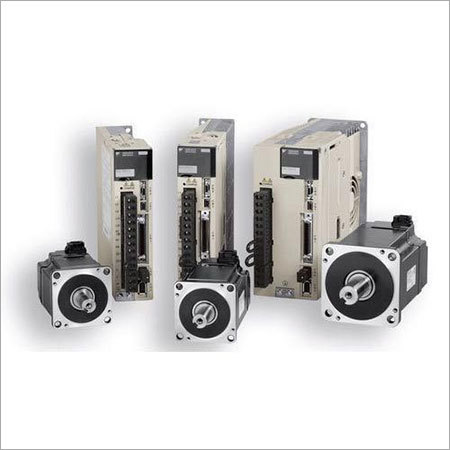
Yaskawa Servo Drives
12500 INR/Piece
Product Details:
- Control Type Digital Servo Control
- Weight 1.2 kg to 8.5 kg
- IP Rating IP20/IP40 (Model Dependent)
- Features Regenerative Energy Capability, Compact Design
- Mounting Type Panel Mount
- Automation Grade Automatic
- Processor Type 32-Bit High-Speed Processor
- Click to View more
X
Yaskawa Servo Drives Price And Quantity
- 1 Set
- 12500 INR/Piece
- Low Noise Operation (<55 dB)
- High with Regenerative Braking
- Fast Dynamic Response (< 1 ms)
- Internal Fan Cooling
- RS-232C, USB
- Sigma Series (SGDV/SGMG/SGMA Variants)
- MotionWorks, SigmaWin+
- ±0.01°
- Overload, Overheat, Overcurrent, Short Circuit Protection
Yaskawa Servo Drives Product Specifications
- AC Servo Drive
- IP20/IP40 (Model Dependent)
- Standard 3 m; Extendable
- Yes
- 0C to 55C Operating
- Digital Servo Control
- Up to 30 Nm (Model Dependent)
- Up to 6000 rpm
- 1.2 kg to 8.5 kg
- 200-240V AC Single/Three Phase
- EtherCAT, MECHATROLINK, Pulse/S-CLINK
- 32-Bit High-Speed Processor
- Servo Drive
- 50/60 Hz
- Single & Three Phase
- CNC Machines, Packaging, Robotics, Printing
- 400 W to 15 kW (Model Dependent)
- Automatic
- Regenerative Energy Capability, Compact Design
- Metal Body, Industrial Grade Components
- Panel Mount
- Incremental/Absolute Encoder Feedback
- Low Noise Operation (<55 dB)
- High with Regenerative Braking
- Fast Dynamic Response (< 1 ms)
- Internal Fan Cooling
- RS-232C, USB
- Sigma Series (SGDV/SGMG/SGMA Variants)
- MotionWorks, SigmaWin+
- ±0.01°
- Overload, Overheat, Overcurrent, Short Circuit Protection
Yaskawa Servo Drives Trade Information
- Nahva Sheva
- Letter of Credit (L/C)
- 100 Set Per Day
- 1 Week
- All India
Product Description
We are one of the leading enterprises, engaged in manufacturing and supplying Yaskawa Servo Drives. These drives are made at our advanced workstations for monitoring feedback signals. They are special electronic amplifiers, which are used to power electric servomechanisms. Moreover, during the monitoring process from servomechanism, it continually adjusts for deviation. They typically work by receiving a command signal from the control system, then it amplifies it and transmits electric current to motor for producing motion proportional to a command signal. Further, offered Yaskawa Servo Drives have various applications in factory automation, robotics, and CNC machining.
Technical specification
| Input Phase | Three Phase |
| Brand | Yaskawa |
| Input Voltage | 230V |
Precision Motion Control for Industrial Automation
Yaskawa Sigma Series Servo Drives offer unrivaled positioning accuracy and dynamic responsiveness, enabling advanced control in critical manufacturing environments. Their digital servo control and high-speed 32-bit processor ensure precise movements necessary for CNC, robotics, and other automation systems. This capability translates to improved product quality and operational efficiency.
Comprehensive Protection & Reliability
Each unit integrates robust protection features, including overload, overheat, overcurrent, and short circuit safeguards, ensuring reliable performance and extended service life. Industrial-grade construction and IP20/IP40 ratings (model dependent) provide added resilience, making them suitable for demanding applications and ensuring minimal downtime.
Flexible Connectivity & User-Friendly Programming
With support for RS-232C, USB, EtherCAT, MECHATROLINK, Pulse/S-CLINK, and programmable via MotionWorks or SigmaWin+, integration into diverse automation setups is seamless. Enjoy remote control capabilities and straightforward configuration, maximizing productivity while reducing setup complexity for engineers and operators.
FAQs of Yaskawa Servo Drives:
Q: How do Yaskawa Sigma Series Servo Drives ensure precise positioning in CNC and robotics applications?
A: These servo drives deliver 0.01 positioning accuracy using high-speed 32-bit processors and advanced digital servo control algorithms. Incremental and absolute encoder feedback further enhance precision, making them ideal for applications such as CNC machining, robotics, and automated packaging.Q: What protection features are available on these servo drives and how do they enhance reliability?
A: Yaskawa Sigma Series Servo Drives come equipped with overload, overheat, overcurrent, and short circuit protection. These safeguards continuously monitor operational status to prevent damage, prolonging the systems lifespan, while IP20/IP40 ratings (depending on model) provide added durability under industrial conditions.Q: When is it necessary to use regenerative braking, and what benefits does it offer?
A: Regenerative braking is utilized during rapid deceleration phases to recover and reuse energy that would otherwise dissipate as heat. This feature not only enhances energy efficiency but also helps maintain low operation costs and supports sustainable manufacturing processes.Q: Where can these servo drives be installed and what mounting options are available?
A: Yaskawa Sigma Series Servo Drives are designed for panel mounting within industrial control cabinets. Their metal body and compact design allow flexible integration into various settings, including CNC machines, robotic assembly lines, and print packaging equipment.Q: What is the process for connecting the servo drive to automation systems, and which communication ports are supported?
A: Integration is straightforward, with connectivity options including RS-232C, USB, EtherCAT, MECHATROLINK, and Pulse/S-CLINK. Set-up and programming are easily managed via MotionWorks or SigmaWin+ software, ensuring fast commissioning and efficient system integration.Q: How does the low noise operation benefit industrial environments?
A: Operating below 55 dB, these drives minimize noise pollution, creating a safer and more comfortable workspace for operatorsespecially valuable in enclosed or densely populated production facilities.Tell us about your requirement

Price:
Quantity
Select Unit
- 50
- 100
- 200
- 250
- 500
- 1000+
Additional detail
Mobile number
Email

Other Products in 'Servo Drives' category

Contact Details

- 22-23, Shukan Mall, Near CIMS Hospital Science City Road, Sola,Ahmedabad - 380060, Gujarat, India
- Phone : 07971549184
POWER TECH SYSTEM
GST : 24AKUPP1158Q1ZB

- Mr Jitendra A. Patel (Proprietor )
- Mobile : 07971549184
- Send Inquiry
 Send Inquiry
|


Our Products
- AC Drives
- Vector Control Inverter
- Variable Frequency Drive
- AC Variable Drives
- Close Loop Vector Drive
- Frequency Inverters
- AC and DC Drive Repair Services
- Delta AC Drives
- DELTA VFD-EL
- VFD AC Drives
- VFD Drives
- Motor Drives
- Inverter Drives
- VFD Repair Services
- AC Servo Drives
- Servo Drives
- Elevator and Escalator Inverter
- Elevator Inverter
- Blower and Water Pump Inverter
- Adjustable Speed Drive
- AC Motor Controller
- DELTA VFD-E
- DELTA VFD-MS300
- Adjustable Frequency Drives
- Hitachi AC Drives
- Programmable Logic Controller
- PG Card
- Repairing Services
- Servo Motor
- Communication Modules Device Net
- Dynamic Braking Unit
- Keypad AC Drives
- Communication Modules And Card Delta
- Display Cable
- EtherNet Communication Card
- Profibus Communication Modules
- Relay Card
- Servo Motor Encoder Cable
- Servo Drive Cables
- Modbus Communication Modules
- I-O Card - Input Output Card
- Delta AC drives
- Delta VFD-C2000 Series AC Drive
- Delta VFD-CP2000 Series AC Drive
- Delta VFD-E Series AC Drive
- Delta VFD-C200 Series AC Drive
- Delta VFD-VE Series AC Drive
- Delta MS300 Series AC Drives
- Delta VFD-ED Series Ac Drives
- Delta Servo Drive and Motor
- Delta VFD-VL Series AC Drives
- Frequency Inverter
- Delta VFD-M Series AC Drives
- Delta VFD-L Series AC Drives
 Send Inquiry
 Send SMS
 Call Me Free
POWER TECH SYSTEM
All Rights Reserved.(Terms of Use)
Developed and Managed by Infocom Network Private Limited.
Developed and Managed by Infocom Network Private Limited.
